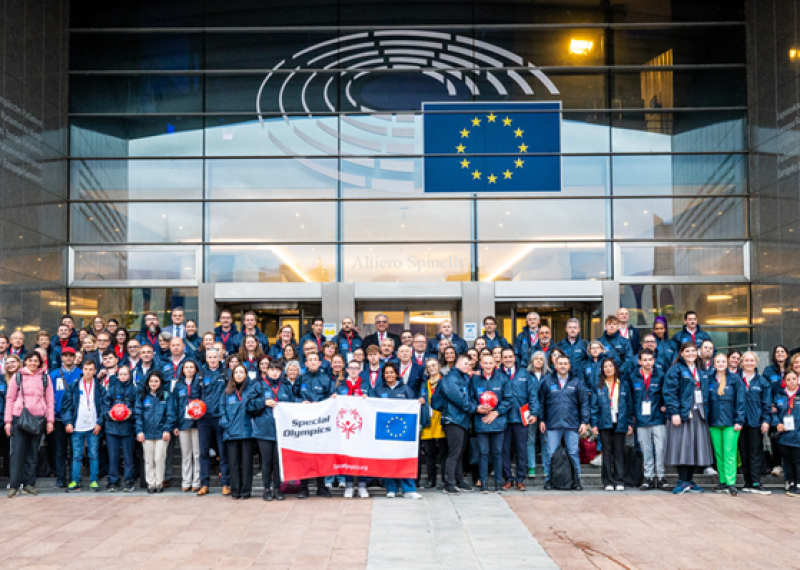



Over 30 years later, in September 2025, he was among the MEPs and European Union (EU) officials who enthusiastically welcomed almost 200 Special Olympics athletes, coaches and staff to the European Parliament and the European Commission for the inaugural and groundbreaking Special Olympics EU Day.
Today, as we celebrate Europe Day 2026, MEP Zdrojewski takes some time to reflect on his personal journey with our movement and the powerful partnership that has evolved and strengthened between Special Olympics and the European Union (EU) over many years of cooperation and collaboration.
Can you tell us about your history of involvement with Special Olympics?
[My first meeting with Special Olympics] was attended by a dozen or so activists and athletes. Interestingly, they were mainly weightlifters. They needed support in terms of facilities and funding, but above all, they needed the community to recognize the group itself.
Times were tough; economic reforms were underway in Poland, and a lot of the burden fell on local government officials. In a nutshell, from that moment on, I have quite consistently supported the various activities of the athletes and the Special Olympics activists themselves.

Why is it so important to you to support the athletes of Special Olympics?
I see not only the determination of the individuals themselves, but also the positive effects for everyone else. Promoting the active participation of people with various disabilities means creating opportunities for them to remain fully engaged both socially and professionally. It means promoting rehabilitation efforts.
More than 30 years ago, I supported the establishment of schools and centers dedicated to restoring functionality in very difficult cases. In Wrocław, Prof. Czamar’s college (Wyższa Szkoła Fizjoterapii we Wrocławiu) is a prime example of success.
In your opinion, what are the values that Special Olympics and the EU share?
Above all, the fight against exclusion. Working to ensure equitable participation. In nearly every document, we emphasize the need to combat isolation, support the vulnerable, and, above all, level the playing field to enable full participation in all aspects of social life. Sport is also a fantastic platform for healthy competition, based on transparent rules and values.
What are your hopes for the future of the Special Olympics-EU partnership?
We are on the right track to use our current experience to eliminate minor errors and further reduce the number of potential exclusions. My recent report on the European Sport Model is excellent proof of this. The support this document received during the vote at the plenary session in Strasbourg was also significant.
What is your message for the athletes of Special Olympics on Europe Day?
Let’s all stand together.