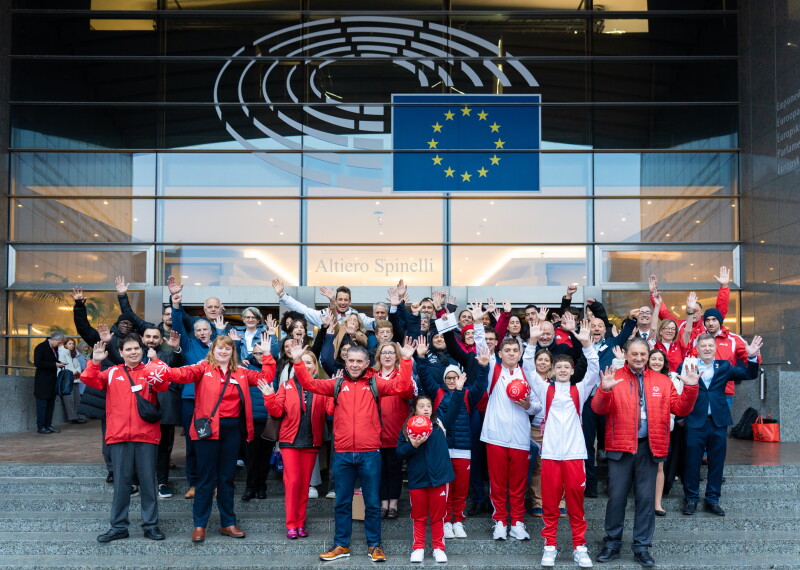


For the second year in a row, Special Olympics athletes from across the European Union (EU) gathered at the European Parliament in Brussels, in the heart of Europe.
Athletes from Belgium, Cyprus, Denmark, France, Germany, Greece, Hungary, Ireland, Italy, Malta, Poland, Portugal, Romania and Spain met with Members of the European Parliament (MEPs) and European Commissioners throughout the two days to advocate for inclusion and ensure that support for people with intellectual disabilities are included in the upcoming Multiannual Financial Framework (MFF), the EU's long-term budget plan.
This year, the athletes demonstrated the breadth of Special Olympics programming in the Spinelli Bar Exhibition Area, located along one of the main thoroughfares of the European Parliament. A compelling photo exhibition portrayed the connection, diversity, and belonging inherent to the global Special Olympics movement alongside a health and wellbeing learning space. A Unified Sports cycling event directly engaged athletes, policymakers, and partners to compete together. The power of sport to unleash fierce determination but also moments of spontaneous joy, laughter and comradery was on show as MEPs and Commissioners from across the political spectrum laughed and cheered as they competed.

On 12 November, Special Olympics athletes, EU high-level representatives, partners, UN leaders, and philanthropy representatives gathered for the Closing Assembly, 'A Strong and Inclusive Europe.' There, representatives from the European Parliament and the European Commission discussed, together with Special Olympics athletes, key priorities for the future of disability inclusion in Europe.
"Special Olympics was once again honoured to take centre stage in the European Parliament in Brussels. The second annual Special Olympics European Union Day was a testament to the powerful ties between the athletes of Special Olympics and the European institutions. Over 100 meetings involving 150 Special Olympics athletes, coaches and staff took place over the course of these two days. It was an honour to share a platform with our athletes. Together, we outlined to our elected representatives and high-level officials the vital role that Special Olympics plays in driving forward the inclusion agenda for Europe for the good of the entire society and economy. We spoke to how essential it is that we are adequately supported by the EU and Member States in order to continue our crucial contribution to creating a healthy, productive and vibrant European society."
Sven added, "Our athletes were keenly aware that they arrived in Brussels at a key moment in the negotiations for the Multiannual Financial Framework (MFF) [the EU's long-term budget plan]. They wanted to help ensure that inclusion of people with intellectual disabilities is no mere lofty ideal but it is written into the terms of the next EU budget. Special Olympics European Union Day 2026 has served to further deepen the connection between Special Olympics and the EU, empowering us to continue forging a pathway forward for a more inclusive Europe."

Special Olympics Ireland Athlete Leader Anita Forde addressed fellow athletes, MEPs and European Commissioners Glenn Micallef and Michael McGrath, at the Closing Assembly in the Parliament.
"For people with intellectual disabilities, inclusion is still a challenge. We want the same opportunities as everyone else … Special Olympics shows that everyone has ability, everyone has something to contribute and everyone deserves the chance to succeed … Continued EU support for Special Olympics is an investment in people, in equal opportunities and in inclusion. As Europe moves forward let us ensure that nobody is left behind and that inclusion remains at the heart of our shared future."

Addressing the Forum, Victor Negrescu, Vice-President of the European Parliament, added, "In this house [the European Parliament] that is often divided, we manage to be united for you [Special Olympics]. Your mission is so important for so many people, within Europe and beyond. Europe, if it wants to succeed, we need to prove to our citizens can indeed do more. Our budget discussions are crucial for the future of Europe but also for your mission … I’ve learnt from your colleagues the efforts that you have conducted over the past few years to deploy screening programmes. It is so important to finance those kinds of initiatives at European level with EU funds as well as at national and local level … We also need to push for a future Erasmus programme that is more accessible and offers more opportunities for organisations like Special Olympics and the citizens that you represent."

Also speaking at the Closing Forum, Glenn Micallef, European Commissioner for Intergenerational Fairness, Youth, Culture and Sport, said, "I am truly blown away every time I meet someone from Special Olympics. It’s the fact that you get people moving, the fact that you give people a sense of purpose, a reason to wake up in the morning, to go to training, to create friendships, I think it’s remarkable … I don’t think I have any words to describe the gratitude when I see programmes like Healthy Athletes, the Healthy Athletes Village every time there is a Special Olympics event, it is just fantastic … My promise is that as long as I am here, you will have a friend and an ally in the European Commission along with the great list of friends that you have in the European Parliament."