

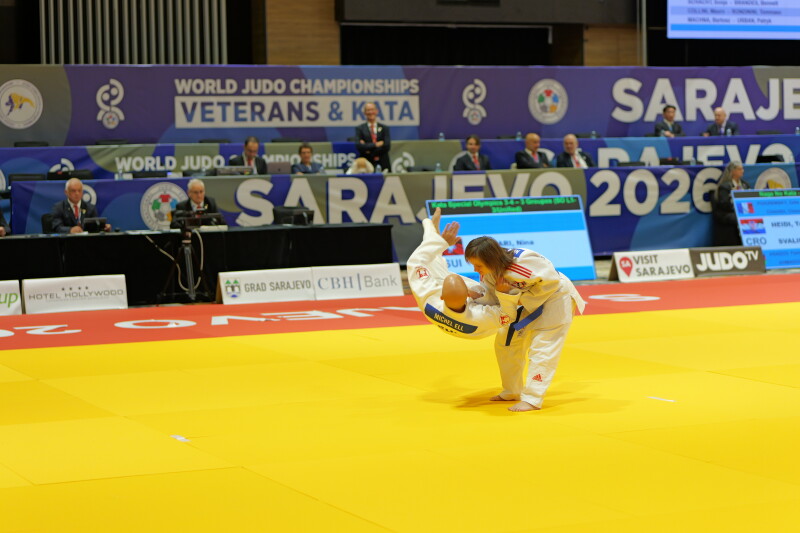
Last September, eight pairs of Special Olympics judokas took to the tatami for a kata competition held at Sarajevo’s Hotel Hills Arena alongside the International Judo Federation (IJF) World Kata Championship 2026.
Kata is a formal demonstration of judo techniques in which two partners perform carefully structured sequences. One judoka takes the role of tori, executing the techniques, while the other acts as uke, receiving them. Success depends not only on technical accuracy, but also on timing, control, coordination, and mutual trust.
The Special Olympics competition in the capital of Bosnia and Herzegovina featured two formats: some pairs consisted of two judokas with intellectual disabilities, while others competed in Unified Kata, bringing together one athlete with an intellectual disability and one partner without an intellectual disability. Across both formats, partners shared responsibility for the quality and flow of the performances, demonstrating the skills developed through training while representing their Programmes before an international audience.
The final results across the competition categories were as follows.
Results:
Kata Special Olympics 1 – 1 Groupe (SO L1-3)
1 ROGENMOSER, Riccy - ROTH, Nikola (Special Olympics Switzerland)
2 REINSPERGER, Franziska - BEATON, Justhin (Special Olympics Germany)
Kata Special Olympics 2 – 1 Groupe (Tori L3-5/Uke Unified)
1 WOHLFAHRT, Johanna - SCHMIDT, Leoni Mieke (Special Olympics Germany)
2 NIFTALIYEVA, Adila - ASLANOV, Ibrahim (Special Olympics Azerbaijan)
Kata Special Olympics 3-4 – 3 Groupes (SO L1-3/Unified)
1 MOLINARI, Nina - ELL, Michel (Special Olympics Switzerland)
2 JERKOVIĆ, Nik - KARANJAC KROFLIC, Tito (Special Olympics Slovenia)
3 WÜTHRICH, Jan - SCHMUCKI, Arlette (Special Olympics Switzerland)
4 IBRAHIMI , Amal - VAN HOYWEGHEN, Walter (Special Olympics Belgium)
Nage No Kata - Kata Special Olympics 4 - 3 Groups
1 WUTHRICH, Jan - SCHMUCKI, Arlette (Special Olympics Switzerland)
Staging the Special Olympics competition alongside the IJF World Kata Championship fostered a strong sense of connection across the sport. Athletes, coaches, officials and spectators were able to experience different expressions of judo within a shared setting.The format also enhanced the visibility of athletes with intellectual disabilities and demonstrated how meaningful inclusion can be integrated into major sporting events through considered adaptations.
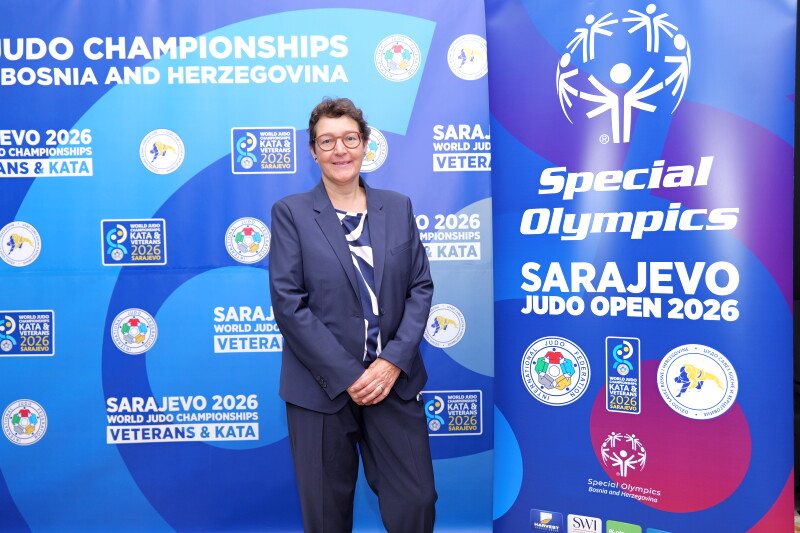
“We are part of the judo family, and we want to show the world that judo is for everybody. With the right adaptations, everyone can participate and be the best in their division," said Cecilia Evenblij.
"Kata provides the structure that is especially important for athletes with intellectual disabilities. Competing in a larger, unfamiliar environment can be challenging, but this event has been a very positive experience. We are still on a journey to help more people understand the Special Olympics philosophy of inclusion, but by learning from one another, Special Olympics and the International Judo Federation can continue to make strides and grow together.”
The Sarajevo competition illustrated why kata is particularly well suited to inclusive judo. Its clear structure supports athletes in preparing and performing with confidence, while its emphasis on coordination, trust and shared responsibility places the partnership at the heart of success.