




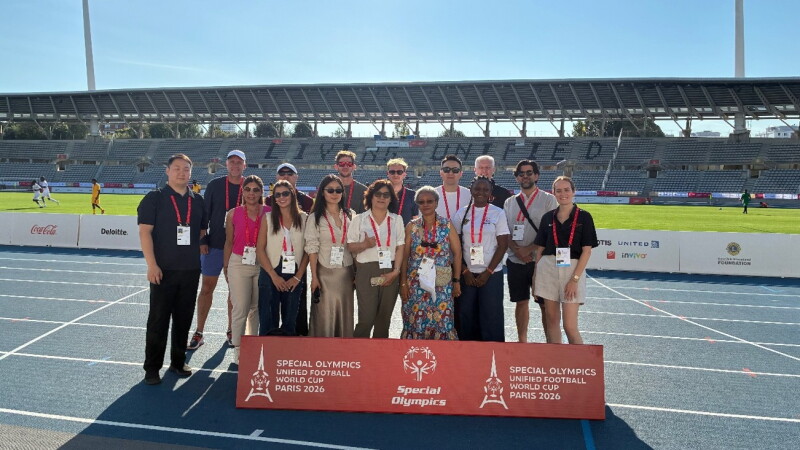
While 24 Unified Football teams from around the world competed on the pitch during the first week of July at the Special Olympics Unified Football World Cup Paris 2026, another important event was taking place behind the scenes.
The Paris 2026 Observer Program brought together 23 government officials and representatives from eight Special Olympics National Programs across four continents: Belgium, Cameroon, Ghana, Korea, Mongolia, Paraguay, Senegal, and Thailand.
Designed for current and prospective hosts of Special Olympics international events, the program provided an immersive look at the planning, delivery, and impact of a world-class single-sport championship.
Observers gained behind-the-scenes access to key areas of event operations, including competition management, commercial partnerships, legacy planning, and non-sport programming. Participants also met with the teams delivering Healthy Athletes and the Motor Activity Training Program (MATP), gaining insight into how Special Olympics creates meaningful experiences that extend well beyond the field of play.
The timing of the Observer Program was particularly significant. As Special Olympics transitions to a new quadrennial cycle for its Unified Football World Cup, opportunities to host future editions are expanding. Following Paris 2026, the next Unified Football World Cup will be held in Asunción, Paraguay, in 2028. Dialogue for the 2032 edition is now underway.
Similarly, following the success of the Puerto Rico 2025 Unified 3x3 Basketball World Cup, discussions have begun for the 2029 edition, with several Special Olympics Programs already expressing interest in hosting.
“Our single-sport world championships showcase the highest level of competition in Special Olympics and give athletes the opportunity to compete on a global stage. They also drive sport development by helping Programs build leagues, forge partnerships, and attract sponsors and media. For hosts, these events deliver lasting social impact, greater visibility, and new opportunities for growth.”
What brought these leaders to Paris was a shared interest in understanding both the mechanics and the value of hosting a Special Olympics international event. They explored not only what it takes to stage a successful competition, but also how such events can drive community engagement, strengthen inclusion, elevate national visibility, and create lasting benefits for athletes and host communities.
For some participants, Paris was the catalyst that transformed interest into action, inspiring plans to pursue a future host bid. For others, it marked the beginning of a longer journey, providing the knowledge, relationships, and confidence needed to engage governments, partners, and stakeholders back home.
As Special Olympics continues to expand its portfolio of international single-sport world championships, the Observer Program plays a critical role in developing the next generation of hosts. Whether a Program is actively exploring a bid or simply beginning the conversation, the opportunity exists to help shape the future of the movement while creating lasting impact for athletes, communities, and countries around the world.


