







Meeting the health needs of people with IDD requires a person-centered approach—one that empowers individuals to take charge of their health journey. People with IDD often face barriers to making decisions about their health, navigating care, and being understood by providers.
The following recommendations can help move towards person-centered care:

Implement and Strengthen Supported Decision-Making
- Update laws and policies to recognize the right of people with IDD to make their own decisions.
- Structure systems to provide:
- Training and guidance for people with IDD and their supporters.
- Easy-to-understand tools like plain language materials, visual aids, and risk-benefit charts.
- Training for health workers and legal professionals involved in assessing a person’s decision-making capacity.
- Mechanisms to support people who need decision-making support, including connecting them to trained supporters, as well as oversight to supporters.

Create Patient Navigator Roles
- Expand focus beyond physical accessibility—accessibility also means support navigating complex systems.
- Establish patient navigation function, through upskilling existing health workers or create new roles to help people with IDD coordinate care and connect with services across sectors.

Improve Quality and Continuity of Care through Focus on Communication
- Use tools like health/hospital passports, longer appointment times, and other accommodations to improve communication.
- Allow and incentivize providers to meet the needs of patients with IDD through accommodations like longer appointment times and queue jumping.
- Standardize and scale prioritization practices across health systems to ensure consistency and impact.

Make Health Information Accessible and Improve Health Literacy
- Provide health education in formats people with IDD can understand, like Easy Read, with a universal design approach. What is accessible to people with IDD often benefits everyone.
- What is accessible to people with IDD often benefits everyone.
Case Studies
Michele, a woman on the autism spectrum who lives in Washington state, was recently diagnosed with type 2 diabetes. At the appointment, the doctor did not ask how Michele prefers to communicate, speaking only about how diabetes would affect her life and lifestyle. The doctor did not stop to make sure she understood what he was saying or use visual aids, which can often make a big difference for people with IDD. Michele also needs extra time to process information or ask questions when she gets overwhelmed. As a result, Michele says the discussion “felt rushed, and I left feeling overwhelmed.”
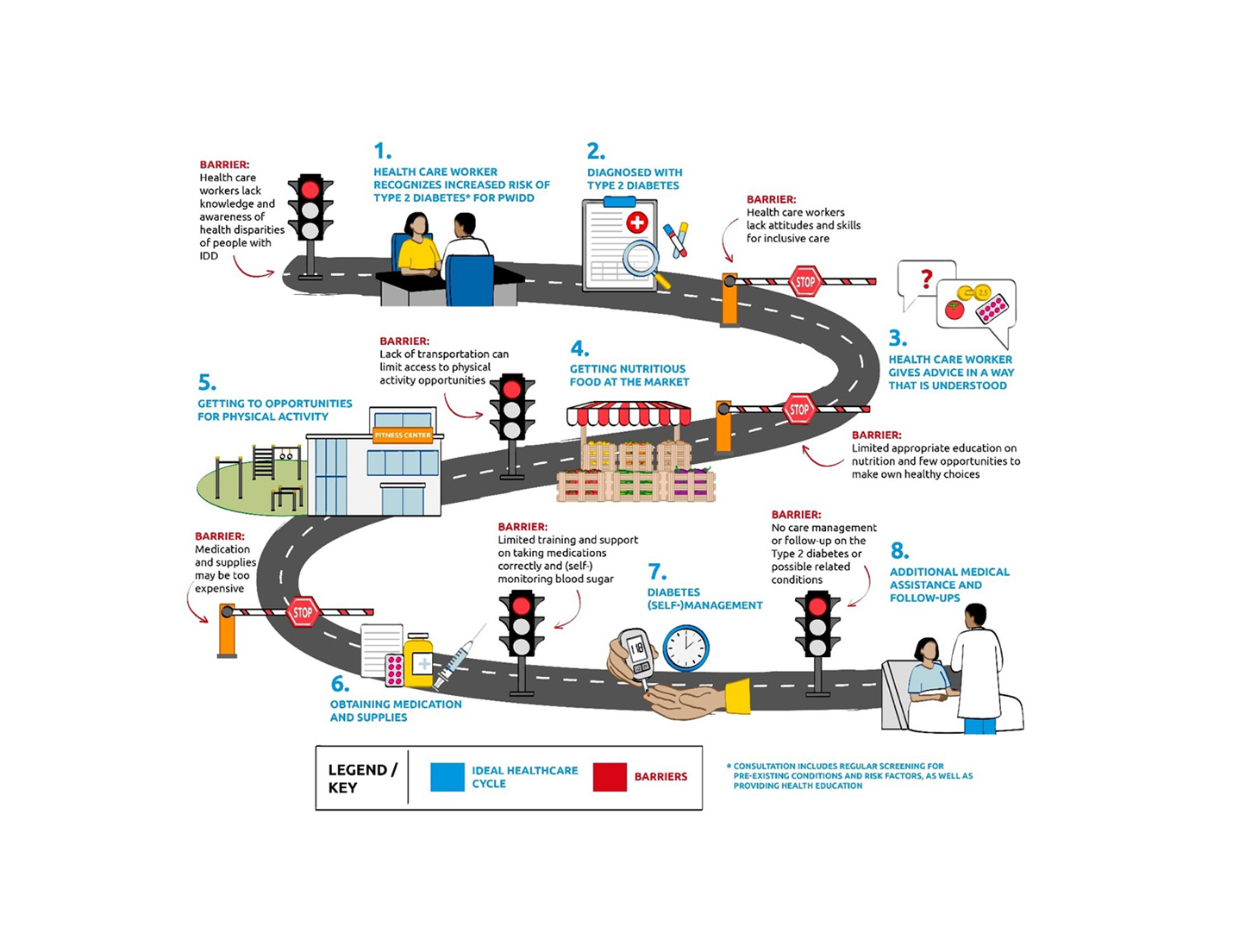
I live in the state of Washington, in the United States. Recently, I was diagnosed with type 2 diabetes. At the appointment, the doctor didn’t ask how I prefer to communicate. He talked a lot how diabetes would affect my life, but it felt rushed. He didn’t use any visual aids or stop to make sure I understood. I left feeling overwhelmed and worried about making mistakes.
I caught a few of the recommendations—he said I needed to exercise more, eat small meals every three hours, and follow a low-sugar diet. He also suggested a diabetic drink, but my first thought was, “How am I going to afford that? I don’t even know if my insurance will cover it.”
Also, there’s no fitness facility nearby where I live. The closest one is over 20 minutes away, and since I don’t drive and there’s no public transportation here, getting there is impossible.
I want to follow the doctor’s advice, but it’s tough. No one checks in to see how I’m doing or if I need help, and it feels like once I leave the office, I’m forgotten. I sometimes need extra guidance and reminders to stay on track, but there’s no system in place to provide that support.

I live in Asunción, Paraguay and I have Williams syndrome. Even though I’m the son of a doctor, my family and I faced many barriers in getting my diagnosis. This is due to the lack of specialized medical knowledge in my country.
From what I’m told, my family didn’t receive support or information when I was little. Throughout my life, I’ve encountered obstacles when trying to access healthcare services, education, and professional training. I’ve even experienced discrimination and bullying.
I just finished university studying social work and am getting ready to defend my thesis. I’m working toward an independent life and becoming autonomous in all aspects of adulthood—including navigating the healthcare system. One major barrier for me is the lack of accessible, easy-to-read information. This makes it difficult to understand how to access healthcare services and make informed decisions.
My mother has always supported me and advocated tirelessly. The support of my caregivers—especially my parents and sister—has been essential. But now we’re in a time of change. They continue to care for me, but they’re also afraid something might happen to me. Sometimes they struggle to accept that I’m an adult. They don’t always know how to support me in this new stage of life. I believe they need more tools to help me transition to a more autonomous adult life.
Ireland’s Assisted Decision-Making (Capacity) Act 2015 represents a global promising practice on this topic. It includes a presumption of the capacity of everyone in Ireland. In order to enable people to make their own decisions, the Act has led to the creation of three types of decision-making agreements, which seek to provide support to those who may face difficulty in making decisions and outlines a functional test to assess capacity. An important feature is that the test acknowledges that capacity is not linear; the test may indicate that a person does not have capacity at one time but does have capacity at another stage. Finally, in order to implement the various elements of the Act, the decision support service was created. This service made available a comprehensive list of protocols and codes of practice for various health professionals to comply with when individuals are deemed not to have the capacity to make their own decisions.

Take Action
Protect and promote provision of health information in Easy Read as a key accommodation. Requiring universal design in health system paperwork and processes can help improve quality and continuity of care, as well as the autonomy of people with IDD.