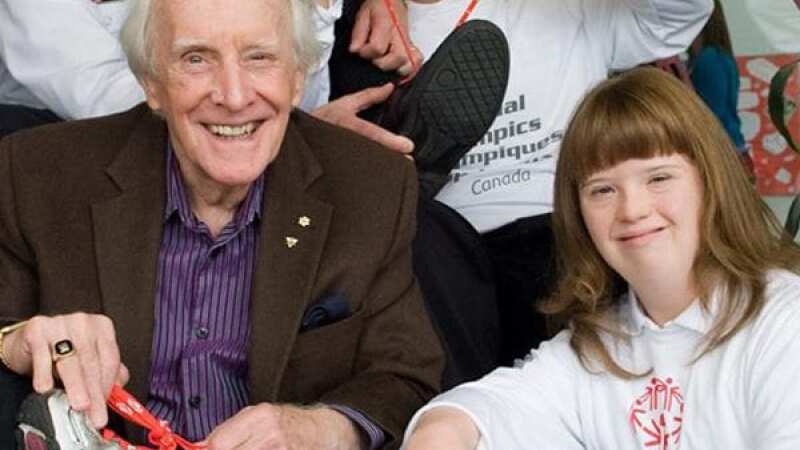


The Special Olympics community is deeply saddened by the passing of Dr. Frank Hayden, a pioneering figure whose contributions to the world of sports and disability advocacy have had a profound impact on generations of athletes and families. Dr. Hayden passed away at the age of 96, leaving a legacy that has transformed countless lives.
Dr. Hayden’s groundbreaking research was the spark that ignited the Special Olympics movement. As a faculty member at the University of Toronto in the early 1960s, his study of children with intellectual disabilities revealed they were half as physically fit as their peers who did not have intellectual disabilities.
It was assumed that their low fitness levels were directly connected to their disabilities. Dr. Hayden’s body of work challenged that mindset—one that claimed it was the disability itself that prevented people from fully participating in play and recreation.
Through rigorous scientific study, Dr. Hayden proved that given the opportunity, people with intellectual disabilities could acquire the necessary skills to participate in sport and become physically fit.
In other words: Sport could have a transformative effect on the lives of people with intellectual disabilities.

In 1964, Dr. Hayden published a book that included sample lesson plans for educators. Astonishingly, this publication sold 50,000 copies and caught the attention of Canadian broadcaster and advocate for individuals with intellectual disabilities, Harry "Red" Foster. Together, they embarked on an effort to launch the Special Olympics National Games in Toronto, though their initial endeavors did not come to fruition.
It wasn’t until 1965, when Hayden received a call from the Kennedy Foundation, that his idea started to gain traction. Eunice Kennedy Shriver, sister of U.S. President John F. Kennedy, was running summer camps for individuals with intellectual disabilities and took a keen interest in Dr. Hayden's research.
This collaboration led to the inaugural Special Olympics Games held at Soldier Field in Chicago on July 20, 1968, where athletes from 25 states and a Canadian floor hockey team, comprised of students from the Beverley School, participated. Harry "Red" Foster, witnessing the event, was profoundly moved and declared, "Frank, this is fantastic. We should have this in Canada."
With Foster's support, the first Special Olympics Games in Canada took place in 1969, and Dr. Hayden continued to expand the movement in the United States. He later played a pivotal role in establishing 50 additional Special Olympics organizations worldwide.
“My idea wasn’t to find the fastest runner with an intellectual disability. It was to make them fitter and healthier, so they have the opportunity to live their potential.”
While the Special Olympics movement mourns the loss of one of its founding figures, Dr. Hayden’s vision lives on every day in communities across Canada and around the world—in every athlete who steps onto a field of play, every family who finds belonging, and every barrier broken through the power of inclusive sport.