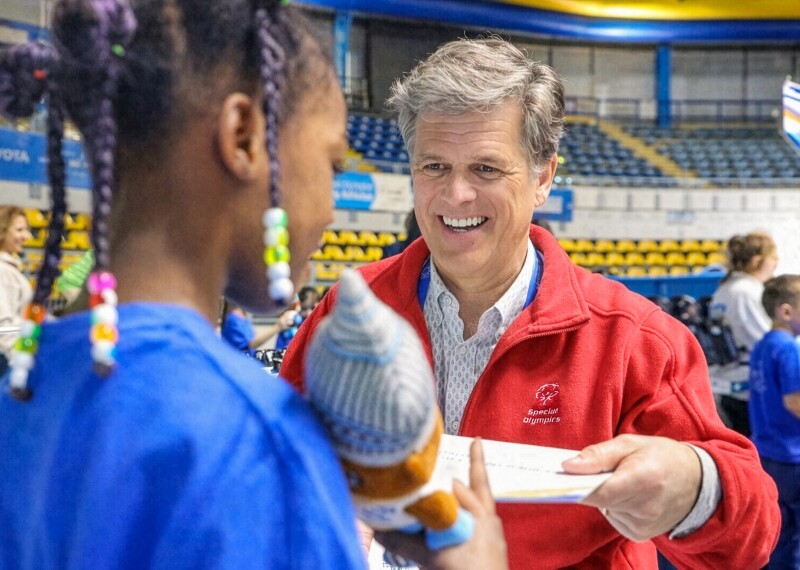


Dr. Timothy Shriver, Chairman of Special Olympics, will receive the 2026 Laetare Medal at the University of Notre Dame’s 181st University Commencement Ceremony on May 17, 2026.
The Laetare Medal—the oldest and most distinguished honor given exclusively to American Catholics—has been awarded annually by the University of Notre Dame since 1883 to individuals whose contributions have enriched the arts and sciences, illustrated the ideals of the Church, and advanced the common good.
Shriver is being recognized for his lifelong commitment to advancing dignity, inclusion, and opportunity for people with intellectual disabilities through his leadership of the global Special Olympics movement.
Shriver’s connection to the Laetare Medal is also deeply personal. He is the only recipient in Notre Dame’s history whose parents were both Laetare Medalists. Eunice Kennedy Shriver received the medal in 1988 for founding Special Olympics, and his father, Robert Sargent Shriver, was honored in 1968 for founding the Peace Corps. Shriver’s uncle, President John F. Kennedy, also received the medal in 1961.
“Being named the recipient of the 2026 Laetare Medal is an honor—not for myself, but on behalf of the Special Olympics movement deeply rooted in dignity,” said Shriver. “My mother and father were also recipients for their service to the community and their belief in the power of humanity—in founding Special Olympics and the Peace Corps, respectively. I accept this award in honor of the bravery, victories, and vision of those who came before me, and those who continue to live out that mission every day.”
Established at Notre Dame in 1883, the Laetare Medal was conceived as an American counterpart to the Golden Rose, a papal honor dating back to the 11th century. The medal is awarded to a Catholic “whose genius has ennobled the arts and sciences, illustrated the ideals of the Church and enriched the heritage of humanity.”
Previous recipients include Dorothy Day, Walker Percy, Sister Helen Prejean, Martin Sheen, and Claire Babineaux-Fontenot, among many others.
For Shriver, the recognition reflects not only his work but the millions of athletes, volunteers and supporters who make up the Special Olympics movement.
“I think it’s being given to me as a placeholder for the people who are doing the work every day,” Shriver told Notre Dame. “It’s being given so that the athlete running a race this afternoon—and their family cheering at the finish line—knows the world is paying attention.”