




The first sign that something extraordinary was happening wasn't inside a stadium. It was at the airport.
After traveling hundreds, sometimes thousands, of miles to Minneapolis-Saint Paul, many families arrived not knowing what to expect. Instead, they were met with an unforgettable welcome. Volunteers filled the airport, cheering as athletes and their loved ones arrived, while Special Olympics USA Games banners lined the terminals, greeting them before they had even stepped outside.
For one mother whose child was about to compete, the experience was overwhelming. As she recounted the moment to Hunter Yang, USA Games Volunteer Services Coordinator, she became emotional, moved by the warmth of the welcome and the feeling that her family truly belonged. It was a remarkable way to begin their USA Games journey.
"She got off the plane and saw the banners," Yang recalled. "She was volunteering with us because her child was competing. She just got choked up. She said how welcoming it felt."
That single moment became the fuel that carried Yang through one of the most demanding weeks of his career.
"Every time my tank started getting low," he said, "I just thought about that impact. I wanted to keep the magic going."
Across Minnesota, that same magic was created by about 13,000 volunteers who filled around 19,000 shifts during the USA Games. They weren't simply helping an event run smoothly. They were creating the experience athletes, families, and coaches would remember long after the competition was over and the medals were awarded.
“The family members of the athletes are all impacted by the event, and really appreciate those who make it happen,” Stacey Helseth, Volunteer Services Check-In Team at USA Games said. “Seeing that appreciation first hand for me is one of the best thank yous I could get.”
From the moment delegations landed until they boarded flights home, volunteers were everywhere and their energy was contagious.


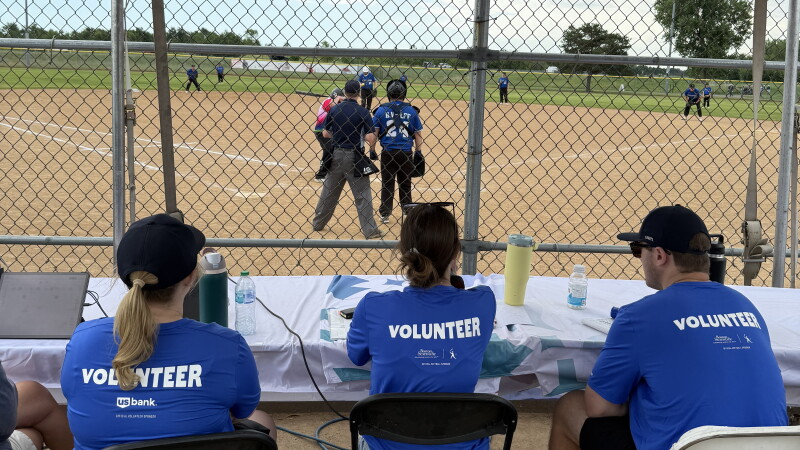
“Volunteering brings out the best in people,” Sandra Larson, Volunteer Services Check-In Team at USA Games said. “It is something everyone should experience one time or another. The athletes bring out the best in humanity.”
They welcomed athletes at airport gates. They served meals in dining halls. They directed transportation, supported Healthy Athletes medical screenings, escorted delegations through Ceremonies, delivered sport on the field of play and kept competitions running behind the scenes. Some roles were highly technical. Others seemed simple. Every one of them mattered.
Volunteer Services Director Carl Wengelewski and Yang took on the enormous responsibility of rapidly building and managing the volunteer program, bringing it to life in a remarkably short timeframe ahead of competition. Working as part of an incredible Local Organizing Committee, with Special Olympics North America, Special Olympics Minnesota, sponsors, the Metro Airports Commission, and hundreds of volunteer leaders, they designed operational plans, built communication models, created volunteer training courses, provided world class customer service, and stayed flexible as the needs of the Games evolved.
"It was everyone pulling in the same direction," Wengelewski said. "Everyone wanted to make this the best event possible."
But no volunteer program of that scale could have succeeded without the people leading it from within. For the Volunteer Services area of the 2026 USA Games, an experienced team of Volunteer Services members played a critical role in preparing for the Games months in advance, developing training, strengthening operations, and providing essential leadership and support throughout the week. As thousands of volunteers arrived each day, they managed day-to-day operations.
"It was an incredible group," Wengelewski said. "Some were engaged early in the year helping us prepare everything, including putting the training together, and they stayed with us through the Games. We couldn't have done it without them."
The number of volunteers alone was staggering, but what stayed with them was the people.
One evening, just as Wengelewski was locking up the volunteer hub, a mother approached him to say thank you. Earlier in the week, the Volunteer Services team at the hub had helped her and her son, who has an intellectual disability, sign up to volunteer together in the dining hall.

The experience changed everything.
Her son impressed the University of Minnesota dining staff so much that they offered him a job after the Games.
"You just made my day," Wengelewski remembered telling her.
Days later she returned with another update. Local television had interviewed her son about his new opportunity.
"It's something I'll never forget," he said.
Stories like that unfolded everywhere.
Volunteers who signed up for a single shift found themselves asking for another. Dining hall volunteers wanted to stay longer. Families discovered new ways to participate. Retirees who thought they were simply giving back left wondering how quickly they could volunteer again.

"I think people think about what they're giving when they are thinking about volunteering," Wengelewski said. "They don't think about what they're receiving. You'll get more out of it than you give."
By midweek, athletes and Unified partners proudly wore their medals and ribbons through campus. Delegations from different states gathered together in dining halls, celebrating one another's successes instead of focusing on rivalries. Closing Ceremony became a massive celebration as athletes danced together on the field, soaking in every final moment.
"I don't think you can get more human than that," Yang said. "Watching somebody experience their life and being themselves, that's the most beautiful outcome."
That atmosphere is what makes a Special Olympics event unlike any other.
"In the world today, there's so much division," Travis Holmes, Special Olympics Manager, Global Volunteers Management said. "Then you come here and you see friendship, unity, inclusion, and people building relationships that will last a lifetime. That's something incredibly special."
In an early post-Games survey, 66 percent of responding volunteers said they had never volunteered with Special Olympics before. Even more remarkably, 92 percent said they would volunteer again.
Many had already asked how.

Holmes found himself repeatedly walking volunteers through how to connect with Special Olympics Minnesota after the Games.
"They'd say, 'I have to do this again. How do I get involved?'" he said.
Perhaps the most fitting example came after the Games had officially ended.
As Holmes waited to board his flight home, he watched a volunteer grab the airport microphone and lead a cheer celebrating the departing Special Olympics New York delegation. The athletes erupted. Passengers applauded. Even the pilots joined in recognizing the delegation before takeoff.
The competition was over.
The volunteer spirit wasn't.
"I came from a corporate background," Wengelewski said. "Being part of an event like this changes your perspective, everyone was completely focused on making this the best event possible.”
Almost immediately after the Games ended, conversations among some Volunteer Services volunteer leaders turned to the next USA Games in 2030.
“You get pulled into the stories and make connections with the athletes as well as other volunteers from different places and different experiences and we all leave better for it,” Helseth said. “The benefit you receive is not realized until you experience it firsthand. I am so appreciative of this opportunity and I am looking forward to the next one I get.”
"We were already saying, 'Let's go do it again,'" Wengelewski said. "If we can go to 2030, we're going."

After experiencing what it means to be part of something bigger than themselves, volunteers from USA Games aren't asking if they'll volunteer again, they're already making plans to return.
“I'll be one of them,” said Wengelewski.


