




“We have to focus on the invisible—the invisible challenges to health services and invisible people, like me.”
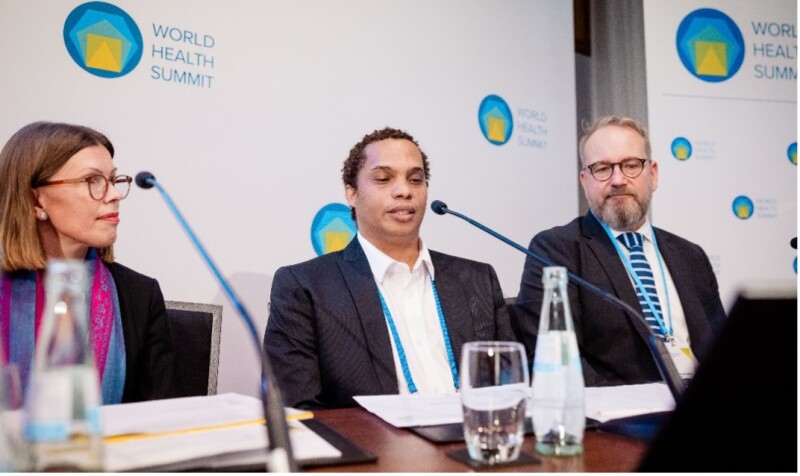
These are the words of Valentino Vergotine, Special Olympics South Africa athlete, Health Messenger, and board member, at the 2025 World Health Summit (WHS) in Berlin.
Opening a session entitled “Bridging the Disability Inclusion Gap: How Health Systems Exclude one in Six People, and What We Can Do About It,” Valentino highlighted some of the barriers that people with intellectual and developmental disabilities (IDD) face when accessing health services. In 2024, Valentino sought medical care for sudden and severe pain that prevented him from engaging in daily activities as well as swimming. At his local hospital, he endured long wait times, received inaccessible information and communication, and faced discrimination.
Unfortunately, this experience wasn’t an isolated instance, but one of the many challenges Valentino has faced while navigating health systems. He shared that sometimes while seeking health services alone he will ask for help with forms. One time when he made this request, the receptionist responded: “What is wrong with you? How old are you? Can’t you read and write?” leaving Valentino feeling dismissed and disrespected.
On another occasion, a nurse and another patient challenged Valentino for being in the queue for older adults and persons with disabilities because of the invisible nature of his disability.
This year’s WHS closely followed the release of Special Olympics’ first global health report, Focusing on the Invisible: The Overlooked Needs of People with Intellectual and Developmental Disabilities and Actions to Strengthen Health Systems for Inclusion. Valentino’s remarks highlighted all too common issues in global health systems, including in his home country of South Africa profiled in the report, and his experience reinforced recommendations in the report related to person-centered care and training of the health and care workforce.
His personal experience also set the stage for the remarks of other panelists speaking on the importance of disability inclusion in health, such as Dr. Tania-Rödiger-Vorwerk, Deputy Director General at the German Federal Ministry for Economic Cooperation and Development (BMZ) Global Health, Resilience, Equality of Opportunity and Darryl Barrett, Disability Technical Lead at the World Health Organization (WHO).

Dr. Rödiger-Vorwerk shared that Valentino’s remarks resonated with her, as she personally has a brother who needs a lot of support. She saw her brother’s experiences with health systems reflected in Valentino’s stories. Dr. Rödiger-Vorwerk spoke about the German government’s commitment and contributions, highlighting co-hosting the Global Disability Summit and showcasing the Amman-Berlin Declaration’s “15 per cent for the 15 per cent” pledge to increase disability inclusion in development assistance. Barrett detailed the steps the WHO is taking to address the health inequities that persons with disabilities live with, presenting the WHO’s new Disability Health Equity Initiative.
This was the third consecutive year Special Olympics co-hosted a session on disability inclusion at WHS together with a global consortium of organizations, including ATScale, the Global Partnership for Assistive Technology, CBM Christian Blind Mission, Humanity & Inclusion, Sightsavers, and the World Health Organization. However, despite filling the room each year, the topic of disability inclusion in health systems has not made it from the margins to the mainstream, where it must be.
Looking Ahead
A gold and silver medalist swimmer at the 13th Special Olympics World Games in Greece (2011) and the 12th Special Olympics World Games in China (2007), Valentino opened the session by talking about how he got his start in swimming: by disobeying his sister’s instructions to stay in the baby pool. Instead he opted for the deep end where, according to Valentino, he jumped, “from the top... to the bottom and the lifeguard saved me.”
In health as in the pool, no one should have to hit bottom to be seen. Health systems must be ready to reach in—not just when someone is sinking, but from the start. Special Olympics is committed to helping health systems be better prepared to reach in for people with IDD.


