




In western Uganda, near the border of the Democratic Republic of Congo, sits Kyangwali Refugee Settlement, which is home to more than 150,000 refugees.
“Behind every single number in the camp there is a face behind it,” said Michael Joel Nabugere, Kyangwali Refugee Settlement Commandant.
Their faces carry stories of war, trauma, separation, and survival. Most of the families arriving have fled from the violence in eastern Congo, often carrying little more than what they can hold in their hands. Some arrive together. Others arrive broken.
“People are trying to give it a shot at life after being disorganized from their country,” Nabugere explained. “It’s either you stay by the gunshots, or you run and have a peaceful place where you can build a small house and try to make a living. Life in the settlement has given a second chance to the people that have fled.”


For Joel and his grandparents, running was the only option.
Before the violence, Zamba Bulo, Joel's grandfather, says they lived a stable life in the Democratic Republic of Congo. Then came the attacks.
“We saw houses on fire,” he recalled. “They were torching houses and killing people. We just ran.”
The family fled through forests as violence spread around them.
“It was killings after killings,” Bulo said quietly. “They use machetes.”
Eventually, they reached a riverbank, climbed into a canoe, and crossed into Uganda seeking safety.
But safety did not erase hardship.
Joel had already lost his parents. Now living with his grandparents in Kyangwali, he also faced another challenge, an intellectual disability and hearing difficulties that often left him isolated from others.
Life inside the settlement is difficult for nearly every family. Food is scarce. Jobs are limited. Trauma is everywhere. Joel’s grandparents, now elderly caregivers, struggle to support him and his younger siblings.
“They are older people living in abject poverty,” said Daniel Sifuna, Chesire Services Uganda Project Manager. “But Joel has to come to school. He also knows he has younger siblings he has to look after, because he is responsible for them.”
For children with intellectual disabilities in refugee settings, the barriers can be even greater.
“Children with intellectual disabilities are normally neglected,” explained Theorists Asingwire, Joel’s teacher. “Some are hidden in houses and not going to school.”
Joel was once one of those children.
“When you could go to see Joel, they could hide him,” said Asingwire. “People thought intellectual disability was a curse.”
At school, Joel often stood alone.
“The first time I saw Joel, Joel was a person who would isolate himself because the learners rejected him,” Asingwire said.
The rejection followed him everywhere. He rarely attended school consistently. He barely interacted with classmates. Even teachers worried about how difficult it would be to reach him.
“At that time, Joel was isolated,” said Asingwire. “You could hardly see smiles.”
Then sports entered Joel’s life.

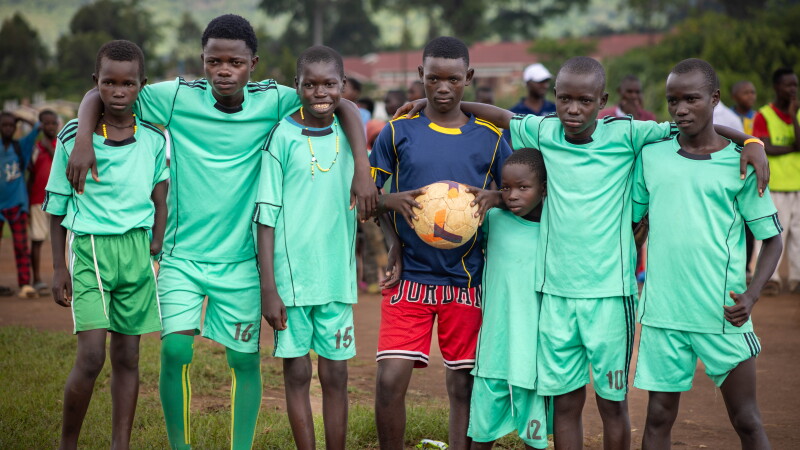


Through Special Olympics Uganda’s Unified Champion Schools program, children with and without intellectual disabilities began playing football together in Kyangwali’s schools. A Special Olympics Unified Champion School offers Unified Sports, inclusive youth leadership opportunities, and whole school engagement.
What started as games, slowly became something much bigger.
“Sports is one sure way first to keep Joel in school,” said Sifuna. “And two, it guarantees the future of this boy.”
At first, Joel only watched from the sidelines.
“But now he’s surrounded by peers,” said Genevieve Bamu, Special Olympics Uganda's national director. “He has friends. Before he was alone, walking alone.”
One of those friends was a student named Byaruhanga Njaba.
“I know he cannot talk,” Njaba said. “But I can talk to him and understand him.”
When others questioned why Joel should play, Njaba defended him.
“I was telling them, you first believe him. We play together and you see how he is going to play. He’s also a person like us.”
The transformation was gradual, but unmistakable.
“Joel is now confident in the class,” Asingwire said. “Previously he would hide himself.”
Now, every Wednesday and Friday, the days reserved for football, Joel arrives carrying a handmade football crafted from banana fibers and scraps of paper.
“He’s telling you that it is the day for playing,” Asingwire said, smiling.
The games changed more than Joel’s attendance. They changed how the community saw him, and how he saw himself.
“Nobody wants to sit with a person they call ‘mad,’” Sifuna explained. “But this has changed. Learners have understood the differences.”
Joel began participating in class. He started helping at home. His grandmother, Josephine Zakwe, says school and sports helped him become more independent.
“He never used to wash his clothes,” she said. “Now he can do it. He is able to put on his clothes properly, fetch water, wash the dishes, and help in the yard.”
On the football field, Joel found something else too: belonging.
“Joel scored more goals than others,” Njaba said. “People were happy. They said, ‘Even this one can also do this.’”
Today, classmates walk to school with him. They eat together. They play together.
“Joel is trying to make the best of his second chance,” said Sifuna. “He has accepted our message. He has come to class. He has accepted leadership roles.”
In a settlement shaped by displacement and loss, it becomes possible to imagine a different future, when a child once hidden away is finally given the chance to belong.
And on football days, when Joel arrives carrying his handmade ball, smiling as his teammates call him onto the field, that second chance becomes impossible to miss.


Special Olympics Unified with Refugees
More about Unified with Refugees


